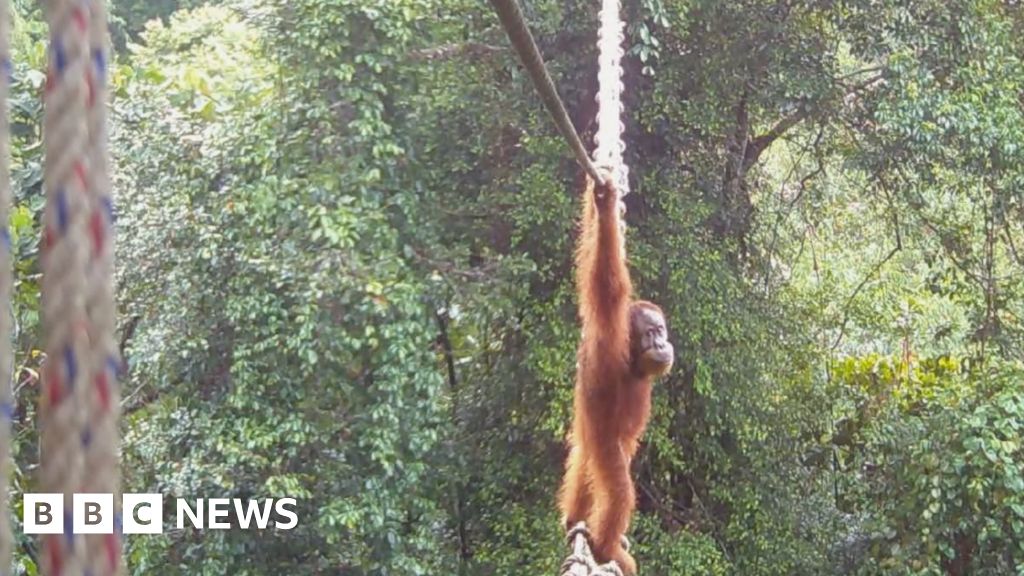
Historic Breakthrough in Indonesian Conservation: Orangutans Cross Man-made Barrier for the First Time
In a remarkable turn of events, Indonesia’s Sumatra witnessed a poignant milestone in wildlife conservation. The construction of a road through the dense forests inhabited by critically endangered Sumatran orangutans threatened to fragment their community, raising alarming concerns among conservationists about inbreeding and potential extinction. Such infrastructural development, often justified as vital for economic growth, increasingly reveals its devastating consequences on fragile ecosystems. The community’s fate hinged on a small but significant act: the orangutans’ willingness to cross a specially built canopy bridge, a symbol of hope and the resilience of nature against human encroachment.
Two years of meticulous planning and collaborative effort culminated when, at last, one brave orangutan took the perilous step across the bridge. This vital connection, facilitated by the Sumatran Orangutan Society (SOS) and Tangguh Hutan Khatulistiwa, with government support, could redefine the future of the species. Historian and environmental analyst Dr. Mark Wilson notes that this crossing signifies more than a moment of animal behavior; it reflects a broader pattern of species adapting amid escalating human activity and serves as a potential template for conservation in other regions facing similar challenges.
- The canopy bridge, designed to reconnect the separated orangutan populations, was long deemed critical to prevent genetic bottlenecks that threaten their survival.
- Despite initial skepticism, the first crossing marks a turning point—and an acknowledgment that innovative conservation strategies can yield tangible results.
- The incident has sparked renewed global attention to the plight of endangered species affected by infrastructural expansion, raising ethical questions about the balance between development and ecological preservation.
The world’s environmental community closely watches Indonesia’s case as a microcosm of the wider geopolitical debate. As developing nations prioritize infrastructure to boost economic growth, international organizations voice concern that such pursuits often come at the expense of vital habitats. The United Nations Environmental Programme (UNEP) and other global bodies warn that without sustainable planning, many species—including orangutans—face irreversible decline. Meanwhile, critics argue that unless global policies shift towards integrating environmental safeguards into economic agendas, the cycle of destruction will only intensify, leaving future generations to grapple with a ravaged planet.
Amidst this complex web of economic ambitions and ecological responsibilities, the fundamental question remains: how does the international community respond to these urgent crises? The crossing of a single orangutan over a man-made bridge may seem small, but it underscores a broader narrative of resilience and the pressing need for global unity. The choices made today will echo through history, shaping the legacy of sustainable coexistence that the world desperately needs. This is a pivotal moment, with each decision echoing the age-old struggle to balance progress with preservation—a testament that the Earth’s enduring story is still being written, often in the footsteps of remarkable creatures like the orangutans who refuse to be erased by human folly.