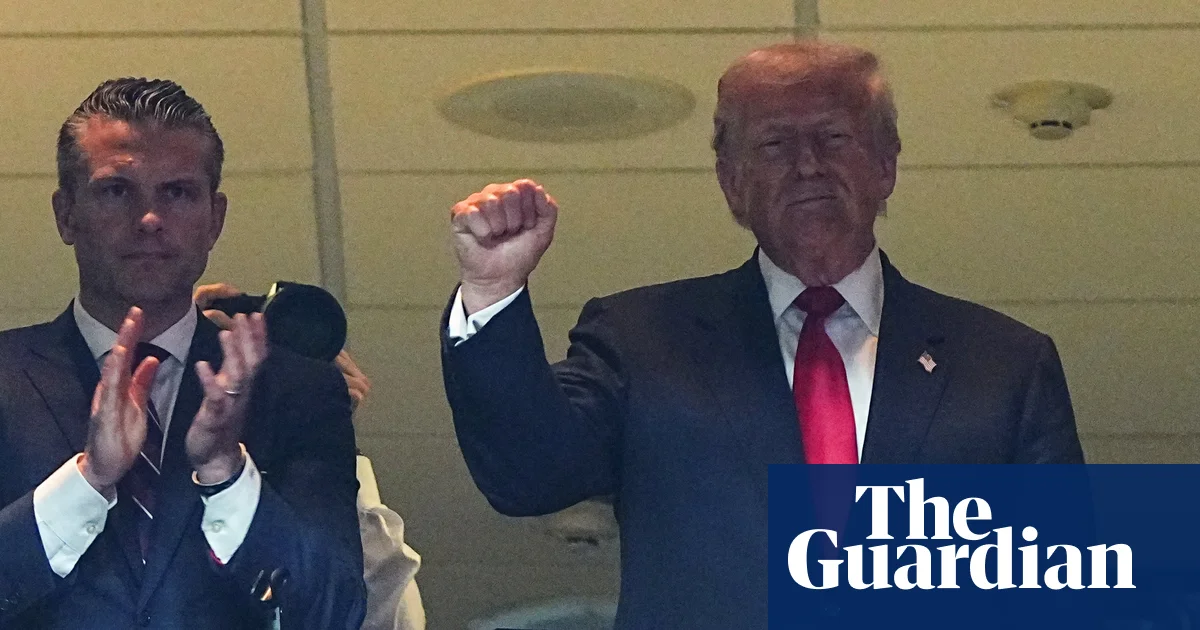
In an unprecedented move that symbolically bridges the worlds of sports, politics, and international influence, Donald Trump made history as the first sitting U.S. president in nearly fifty years to attend a regular-season NFL game. His presence at the Washington Commanders’ match against the Detroit Lions not only ignited heated reactions among fans but also served as a vivid display of the ongoing cultural and geopolitical fractures within America. While crowds in Washington, D.C., expressed their mixed sentiments—ranging from cheers to boos—the spectacle underscored how deeply divided the nation remains, and how influential figures from the global arena continue to leverage sports as a stage for political statement and influence.
This public spectacle is more than just a partisan protest; it reflects a broader geopolitical narrative where domestic political conflicts are playing out under the watchful gaze of the international community. Historically, such the attendance of a sitting U.S. president at an NFL game signals the importance of national identity and internal cohesion. Yet, the reactions from the crowd—boos, chants, and jeers—highlight a nation polarized along ideological lines. Experts remind us that the U.S.’s internal fractures are, in many ways, echoed globally, as international powers observe and interpret America’s political turbulence on every stage, from the battlefield to the sports arena.
The event also has implications for geopolitical positioning. Trump’s desire to have the Commanders’ new stadium named after him, as revealed by reports of White House intermediaries, demonstrates how branding and influence extend beyond politics into the realm of international soft power. This project, valued at nearly $4 billion, symbolizes a broader trend: the merging of economic ambitions with national identity—an ambition echoed in the development of international alliances and contentious treaties. As noted by several international analysts, such moves can be seen as the embodiment of a nationalist resurgence aiming to solidify American influence domestically while projecting strength internationally.
Furthermore, this event occurs amidst a global chessboard, where neighboring and distant powers watch as internal tensions simmer. Historians caution that when national symbols become politicized—such as debates over stadium naming and the involvement of political figures in civilian life—it can have far-reaching effects on a nation’s international image and diplomatic relations. The spectacle of a U.S. president mingling with military personnel during the game, and the NFL’s participation in patriotic initiatives, serve to reinforce a narrative of resilience amid division. Yet, critics argue that this superficial unity masks underlying societal conflicts that could, if left unaddressed, lead to fragile stability.
As the weight of history presses down, the unfolding story of Trump’s NFL appearance is more than a fleeting media event. It is a mirror held up to a world grappling with its own divisions and aspirations. While leaders and analysts debate the implications, the image of a polarizing figure standing amidst cheers and jeers at a sports stadium echoes a deeper truth: the forces shaping the future are playing out in arenas of both national pride and international influence. It is a reminder that history is a constant battlefield, where every gesture and decision—no matter how seemingly trivial—can ripple across borders, shaping the course of nations for generations to come.