

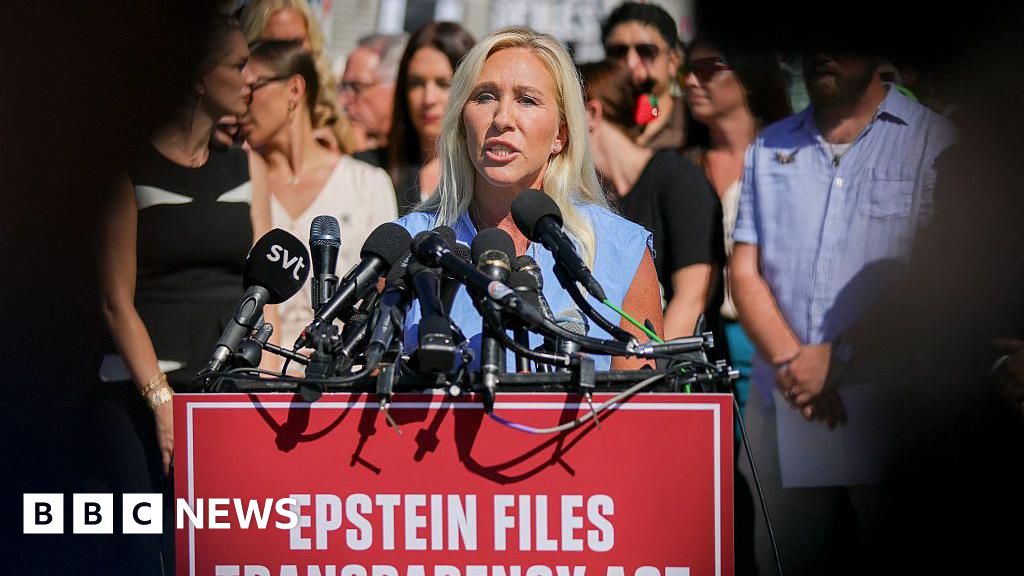
The recent rift within the Republican Party in the United States signals a rising tide of internal conflict that could have profound geopolitical implications. At the heart of this political earthquake lies President Donald Trump’s sharp withdrawal of support for Congresswoman Marjorie Taylor Greene, a vocal conservative now accused of drifting towards the “far left”—a term rare for figures within the traditional GOP. This spat exposes the growing fissures among conservative factions who once aligned under the Trump banner but are now diverging over key issues like foreign policy, the handling of sensitive documents, and the direction of the broader American nationalist movement.
Historian analyses and strategic think tanks highlight how the decision by Trump to openly criticize Greene and endorse a primary challenger could ripple beyond domestic politics, impacting America’s diplomatic stance. The tensions are centered around the ongoing battle over the Epstein files, with Greene and a handful of GOP allies calling for transparency, contrasting sharply with Trump’s fierce opposition framed as an effort to suppress potentially damaging information. Such internal discord signals a weakening of traditional party cohesion at a critical juncture as the US faces escalating foreign conflicts and economic challenges. The international community watches intently, aware that internal US divisions can weaken the global position of a nation that has long styled itself as the leader of the West.
Amidst this turmoil, Trump’s rhetoric has become increasingly combative, claiming Greene’s criticism stems from personal grudges and alleging that her dissatisfaction stems from his refusal to efficiently communicate. His accusations—particularly that she is “complaining” and turning on him due to political ambitions—are viewed as part of a broader strategy to consolidate loyalty within the party by framing dissenters as disloyal or misguided. Meanwhile, Greene has responded by accusing Trump of trying to suppress the Epstein files, asserting that his actions are motivated by political self-interest aimed at protecting high-profile figures and thus complicating America’s efforts to confront its past and uphold justice. Her staunch stance has gained traction among younger voters who demand accountability and transparency, critical elements for future political reform. This intra-party battle underscores the enduring tension between populist nationalism and traditional conservatism—a struggle that could shape American policy both at home and abroad.
International organizations and analysts warn that this internal strife, if left unresolved, could diminish the United States’ ability to project strength and coherence on the global stage. With Europe, Russia, and China recalibrating their strategies amidst the chaos, a fractured America risks ceding strategic advantage. The unfolding drama surrounding the Epstein files exemplifies how domestic narratives intersect with broader geopolitical currents—each revelation or suppression affecting American credibility, especially among allies and adversaries alike. As the midterm elections approach, the internal party conflicts threaten to further polarize an already divided nation, raising questions about the future direction of American foreign policy in an era marked by historic volatility.
In the long shadow of history, this feud reflects more than just personalities—it embodies the fundamental struggle over who defines the American identity and how the values of transparency, loyalty, and national sovereignty are prioritized. As observers and historians track this clash, they warn that American internal cohesion remains fragile. The stakes extend beyond mere politics, touching on issues of justice, accountability, and the very soul of a nation that has historically wielded enormous influence in shaping world affairs. The unfolding story of Trump, Greene, and the Epstein files is still being written, but its echoes are already reverberating across the globe—reminding all that in history’s grand chessboard, internal conflict often precedes transformation, and the winds of change are blowing fiercely across the landscape of modern geopolitics.












