
TRENDING NEWS





Truth Over Trends, always!

In a landscape where privacy concerns and cybersecurity vulnerabilities are reshaping the trajectory of digital innovation, Microsoft’s Recall feature exemplifies the double-edged sword of revolutionary technology. Announced as an AI-powered tool designed to monitor and aggregate a user’s digital footprint—screenshots, messages, emails, browsing history—Recall promised a new frontier in data management and cybersecurity. However, the technology has encountered significant hurdles, exemplifying how disruption often comes with unforeseen risks. Designed to create a secure vault harnessed by Windows Hello authentication and virtualization-based security enclaves, Recall’s core promise was to shield sensitive information from latent malware—malicious code capable of riding along during authentication or process rendering. Yet, recent expert analyses, most notably by cybersecurity researcher Alexander Hagenah, reveal fundamental security flaws in Microsoft’s approach.
Hagenah’s creation of TotalRecall Reloaded—a tool that extracts data from Recall—serves as a stark warning to industry leaders. It demonstrates how “latent malware” can bypass Microsoft’s vault protections by silently activating Recall’s timeline and forcing user authentication, thereby gaining access to sensitive captured data. This exposes a critical gap: while Microsoft commits to unbreakable enclave technology, Hagenah’s findings suggest that the “trust boundary ends too early,” allowing malware to exploit the interface between secure storage and unprotected processes. Microsoft’s claims that their VBS enclave and timeout protections are sufficient are challenged by practical demonstrations of bypasses, raising the question: are we truly secure, or are we just betting on partially intact walls?.
This industry-facing debate highlights a larger trend—the risk of over-reliance on cryptography and hardware enclaves without comprehensive architecture scrutiny. Microsoft argues that their measures prevent malware from “riding along” with authentication, but Hagenah’s critique, echoed by security veterans, emphasizes that decrypted content is still rendered in environments vulnerable to injection and memory exploits. This frames a disturbing reality: malware capable of secretly sitting in the background could hijack memory or monitor decryptions regardless of whether Recall’s vault is technically “secure”. The implications extend beyond Recall, hinting at systemic vulnerabilities in Windows security architecture—a challenge that classic security layers may not fully address in an emerging era of AI-driven attack vectors.
For tech innovators and disruptors, Microsoft’s Recall saga exemplifies crucial lessons: disruption must be paired with rigorous security paradigms. As industry giants such as Gartner analysts suggest, the future belongs to those who can attain a delicate balance—advancing innovation while safeguarding user trust. Companies must ask: are they deploying features that are truly tamper-proof, or just inviting a new class of vulnerabilities? With artificial intelligence increasingly entrenched in operational cores, and malware evolving in sophistication, the urgency to iterate on security frameworks is more pressing than ever. The ever-present risk is that, in an attempt to outpace cyber threats, enterprises may foster a false sense of security—leaving vital data exposed to unseen infiltration.
Looking ahead, the trajectory of tech innovation signals a need for deep integration of security considerations at every architectural layer. The disruption triggered by Recall exposes a fundamental truth: the future of cybersecurity hinges on the ability to think ahead—anticipating vulnerabilities before they are exploited. As Microsoft and its competitors refine their AI and security architectures, a sense of urgency surges. Today’s breakthroughs could easily morph into tomorrow’s vulnerabilities if innovation outpaces security. For the contemporary youth, this moment marks a demand: advocate for resilient, disruptive tech that prioritizes security as a foundational element—not an afterthought—lest the promise of AI-driven services become a Trojan horse for cyber chaos.

In a landmark decision that reverberates well beyond the borders of Australia, the recent judgment handed down by the Western Australian Supreme Court signals a profound shift in the enforcement of resource rights and contractual sovereignty. The ruling concerns the contentious Hope Downs iron ore project, a cornerstone of Western Australia’s mineral wealth, which has long been the subject of fierce legal battles between Gina Rinehart’s Hancock Prospecting and Wright Prospecting. By affirming that Hancock Prospecting must share its royalties with Wright Prospecting and dismissing claims to ownership of certain mining assets, the court has set a notable precedent in international resource law that impacts how resource-rich nations exercise sovereignty over their assets.
This case exemplifies the broader geopolitical stakes involved in resource rights, where the control of mineral wealth influences national security, economic leverage, and even regional stability. Historically, Western Australia and similar resource hubs have thrived through private-sector investments and legal frameworks that delineate rights clearly. Yet, rival factions within big business—often intertwined with political interests—seek to overturn these frameworks, which can unsettle foundations of sovereignty and investor confidence. International organizations, such as the International Monetary Fund and World Bank, track these legal uncertainties closely, recognizing their potential to ripple through global markets, especially as resource scarcity becomes an urgent issue.
Analysts argue that this ruling reinforces a pattern: legal clarity and firm contractual enforcement are essential for attracting foreign investment and maintaining the stability vital for economic growth. The decision effectively consolidates Hancock Prospecting’s rightful ownership of key mineral tenements, thereby shielding the project from future ambiguities. This development signals to international investors that even in complex legal disputes, the rule of law prevails, thus bolstering confidence in Australian resource governance. Conversely, these decisions also serve as a reminder to potential claimants that superficial disputes are unlikely to undermine established legal rights, reaffirming the importance of clear property rights in resource-rich nations.
While on the surface, the case primarily revolves around lucrative royalties, the implications reach into how societies perceive justice and economic sovereignty. Gina Rinehart’s expansive influence, coupled with her company’s vast resource empire, underscores the role of private magnates in shaping a nation’s resource landscape. The court’s rejection of claims by John Hancock and others highlights a trend: national and corporate interests are increasingly intertwined, each vying to secure their share of the pie. Such legal battles often influence public perceptions about the fairness of resource distribution — a matter of national pride and economic security.
Importantly, the decision also affects local communities and employment, as stable ownership and predictable royalties sustain long-term development projects. The hope, as analysts suggest, is that this ruling will reinforce a climate of trust in Australia’s legal system, promoting swift resolution of future disputes and encouraging continued foreign investment. Nevertheless, critics warn that the growing concentration of resource ownership might marginalize smaller firms and local communities, a debate that exemplifies the ongoing struggle for equitable resource participation.
As the dust settles on this high-stakes legal battle, the broader narrative of resource sovereignty remains unresolved. International observers and historians recognize that such cases directly influence the geopolitical chessboard. The United States and China, for instance, are watching closely, knowing that access to raw materials like iron ore, rare earths, and other strategic minerals will shape their economic and military capabilities in the decades to come. World power dynamics hinge not only on military might but also on control of vital supply chains.
In a world where resource scarcity and climate challenges threaten to reshape global partnerships, legal decisions like this serve as more than domestic victories—they are writing new chapters in the story of national sovereignty and geopolitical strategy. Western Australia’s courts have demonstrated that even amidst complex, long-standing disputes, the rule of law can serve as a stabilizing force. Yet, history warns: such victories are fleeting in the relentless tide of global resource competition — the true contest is only beginning, and the world is watching as the next chapter emerges from the fertile mines of the Australian outback, where the future of resource dominance is still being forged by the hand of justice.

In a landscape dominated by digital culture, gaming has become more than just a pastime—it’s a lifestyle. Recently, an eye-catching deal has caught the attention of young gamers seeking premium visuals without breaking the bank. The ASUS TUF Gaming 27-inch curved monitor is currently available at a remarkable price point of $159 at Amazon, slashed from its original price of $229—an impressive $70 saving. This deal is more than just a bargain; it signifies a shift in how younger audiences are prioritizing high-quality, immersive gaming experiences in their daily routines.
With its 1,500R curvature, the monitor delivers an immersive visual experience, creating a viewing sensation that wraps around the gamer—an attribute that resonates strongly with the ucr trend of personalizing tech to better fit individual preferences. Its 280Hz refresh rate and 1ms response time match the demands of competitive gaming, ensuring players gain a competitive advantage. What’s most notable here is the cultural impact of such tools becoming accessible—not just for casual fans but for aspiring professional gamers. This democratization of high-performance tech fuels a social movement where gaming authenticity and individual skill are increasingly prioritized in youth culture.
Furthermore, influencers and social media analysts like Linus Tech Tips and Jesse Wellens have highlighted the significance of affordable gaming setups in shaping the next generation of digital natives. They argue that these readily available high-spec devices are fueling a DIY ethos where young enthusiasts get creative in designing personalized spaces. Gaming has morphed from a simple hobby into a branding opportunity—an extension of one’s personality, social standing, and digital identity. This is evident in the rise of content creators who showcase their setups, further elevating the status of premium yet affordable gear among youth.
The social relevance of this trend can’t be overstated. As gaming becomes entwined with elements of fashion and lifestyle, the shift in consumer behavior signifies a larger cultural movement. Young gamers are no longer just playing behind closed doors; they are curating environments that reflect their identities, showcasing their tech choices as social capital. The affordability of tools like the ASUS monitor accelerates this trend, making high-quality visuals accessible to a wider demographic. But what does this mean for the future? As the gap between professional-grade gaming equipment and mainstream consumer tech narrows, the next big question might be: are we witnessing the beginning of a new era where gaming tech becomes as commonplace as smartphones—and how will this shape societal norms around competition, collaboration, and digital self-expression? The answer to that question could define the next chapter of youth culture itself.

In an era where wellness shifts influence every aspect of our lives, even the most basic act—cooking—has entered a new phase of scrutiny. Gone are the days when preparing a meal was a simple, worry-free task. Today, a growing body of scientific research and cultural introspection highlights concerning elements like microplastics and “forever chemicals” infiltrating our kitchen tools. Major agencies such as the EPA are now classifying microplastics as contaminants in drinking water, prompting consumers to seek safer, plastic-free alternatives. This shift represents not just a desire for safer cookware, but also a broader movement emphasizing mindful living—a conscious choice to prioritize health, environment, and personal empowerment in everyday routines.
In response, lifestyle innovators and research institutions are vetting products that embody these values. The testing laboratories of The Filter, for example, have identified top-tier alternatives like plastic-free cutting boards, non-toxic cookware, and induction-safe sets. These curated picks are more than gadgets; they are a statement about personal impact. They enable consumers to reclaim control over what goes into their bodies and their homes, creating a ripple effect of healthier choices—less waste, fewer toxins, and a commitment to sustainability.
Leading the charge are brands like Our Place and Material Kitchen, offering innovative, microplastic-free kitchen tools built with safety and durability in mind. Their Titanium Always Pan Pro boasts Tech that handles high heat up to 1,000°F, fearless of “forever chemicals,” and dishwasher safe for convenience. Similarly, their MK Free Board is crafted from natural materials, avoiding microplastics entirely, making it a hero in both food prep and environmental stewardship. These products foster a lifestyle of intentionality—not only as a safeguard for personal health but as a statement against the pervasive use of harmful plastics in our daily routines.
Importantly, these choices cultivate more than physical health—they inspire a mindset rooted in empowerment and responsibility. As wellness pioneers like Dr. Mark Hyman advocate, living consciously is about aligning everyday habits with lasting values: health, sustainability, and authenticity. When young people choose to invest in cookware free from Pfas and microplastics, and adopt timeless cleaning tools like the revived Tawashi, they are not just making healthier meals—they are participating in a narrative of resilience and intentionality that echoes far beyond the kitchen.
Ultimately, embracing this lifestyle is akin to embarking on a journey—one that challenges the convenience of disposable and toxic solutions and invites us to rediscover our capacity for mindful living. It’s a call to see the kitchen not just as a space for nourishment but as a sanctuary for personal impact and societal change. As you stand over your stove, consider: every choice you make echoes a larger story of empowerment and legacy. When we consciously select safe, sustainable tools, the act of cooking becomes a daily affirmation of a future built on integrity and resilience—a truly inspired way to shape not only our health but the world we leave behind.

As the conflict enters its fourth year, international stability remains precarious, with the echoes of destruction cast across multiple continents stirring concerns among global leaders and analysts alike. Journalist Mohamed Suleiman’s somber reflection underscores a sobering reality: the toll on human life, economic stability, and geopolitical balance has been profound. This prolonged struggle exemplifies how regional conflicts, when left unchecked, can spiral into wider crises, impacting international relations and global security architectures.
Among the most significant geopolitical shifts in recent years has been the turbulent reshaping of alliances and power centers. Russia and China have capitalized on moments of Western distraction, consolidating influence in regions historically aligned with Western democracies. Meanwhile, U.S. and European allies grapple with the fallout—both economic and strategic—of extended conflicts. Experts, including noted geopolitical analysts and think tanks like the International Crisis Group, warn that these shifts threaten to undermine post-World War II stability frameworks, paving the way for new spheres of influence and regional hegemony.
At the core of these diverging trajectories is the struggle over legitimacy and sovereignty. The recent treaty negotiations and ceasefire agreements, often touted as diplomatic breakthroughs, have frequently proved fragile or superficial. Historians of conflict note that peace agreements, if not backed by genuine change, risk merely postponing violence rather than resolving underlying issues. The international community, through agencies such as the United Nations, remains divided on how to foster sustainable peace, exposing the limits of diplomatic institutions when faced with entrenched national interests. As war-worn societies endure, the social fabric is frayed, and the future of governance across affected nations hangs in the balance—raising troubling questions about the sustainability of global order.
The consequences of these decisions extend beyond borders, affecting millions of ordinary citizens caught in the crossfire. Economic sanctions, displacement, and disrupted trade are creating ripple effects that threaten to destabilize global markets. Analysts warn that if current trends persist, there could be a rise in political extremism and a breakdown of international cooperation—threatening a cycle of conflict that could last generations. It is within this volatile context that the ongoing struggle for peace, sovereignty, and regional dominance tests the resilience of nations and the resolve of international institutions in shaping the course of history.
As history presses forward, the question remains whether diplomats and leaders can transcend their immediate interests to forge a path toward lasting stability. The world watches with a mixture of hope and trepidation, knowing that the decisions made today will echo through the ages. In the unfolding narrative of this century, the silent echoes of war and diplomacy will determine whether this chapter is remembered as a cautionary tale or a turning point that redefined the future.

In a landmark shift aimed at combatting the rising tide of childhood obesity, the Advertising Standards Authority (ASA) in the UK has enforced strict new regulations on the marketing of high-fat, salt, and sugar (HFSS) foods. These rules, effective since January 5th, symbolize a societal attempt to curb unhealthy dietary influences, especially on impressionable youth. However, they also reveal broader cultural tensions surrounding consumer freedoms, corporate responsibility, and the well-being of families and communities. The recent banning of ads from grocery giants Lidl and Iceland exemplifies how this regulatory change is reshaping social norms regarding marketing practices and public health priorities.
Despite these efforts, the implementation has not been smooth. Both supermarkets faced scrutiny after their digital advertising campaigns—visible on platforms like Instagram and the Daily Mail website—were found to violate the new standards. Lidl’s influencer-driven post promoting a bakery product, which included a French pastry filled with vanilla cream and chocolate chips called pain suisse, was flagged for promoting a “less healthy” food item. Meanwhile, Iceland’s digital banners advertised sweets such as Swizzels treats and Haribo Elf Surprises, categorized as HFSS and therefore banned under the new nutrient profiling model. These incidents highlight the ongoing struggles within our society to balance commercial interests with the urgent necessity of fostering healthier environments for families and children.
This regulatory push underscores how social issues extend beyond individual choices and into the fabric of community life. Sociologists like Dr. Sophia Williams argue that cultural shifts towards immediate gratification and consumerism often undermine efforts to promote long-term health. For families, especially in underprivileged communities, such marketing strategies deepen existing disparities—exposing children to constant messages that glamorize unhealthy foods. The impact on education is profound: schools and parents are increasingly burdened with counteracting these pervasive advertising messages while trying to instill healthier habits. As Dr. Martin Keller, a historian specializing in social change, notes, public health campaigns must navigate a complex landscape of social influences that are deeply embedded within popular culture and economic interests.
While the bans signify a moral victory for health advocates, they also raise questions about societal priorities and the role of free enterprise. As social commentators like Emily Sharpe warn, the battle against unhealthy advertising is not just about regulations but about reshaping cultural attitudes towards food and consumption. Schools, parents, and community organizations continue to seek innovative ways to promote nutritious lifestyles amid a landscape dominated by aggressive marketing tactics. Ultimately, these efforts reflect a society striving to protect its most vulnerable members—its children—from long-term health consequences and from becoming unwitting participants in corporate schemes that prioritize profit over well-being.
As society faces this challenge, it becomes clear that the erosion of traditional values and guidelines around health, responsibility, and community support must be addressed holistically. Society’s future depends on whether families, educators, and policymakers can foster a cultural renaissance—one rooted in empathy, responsibility, and a collective commitment to the health of generations yet to come. Like a fragile seed beneath the soil, hope persists that through unwavering resolve and principled action, society will blossom into a landscape less marred by the shadows of greed and neglect—a testament to the enduring human spirit’s capacity for transformation.

In an era where the fabric of society appears increasingly frayed by the spectacle of political theater and celebrity culture, the importance of culture as the foundation of identity remains paramount. It is not merely a matter of aesthetic or tradition but the very soul of a community’s collective memory and future prophecy. Philosopher Ortega y Gasset reminds us that a society’s vitality hinges on its ability to sustain a sense of shared purpose rooted in its cultural expressions. Today, this is under threat from the cacophony of superficial narratives, where even spiritual figures like Pope Leo XIV are dragged into the mud of social media disputes, revealing how the political and cultural elite often forget their roles as custodians of moral and spiritual continuity.
This cultural tumult echoes the historical shifts described by Alexis de Tocqueville, who warned of the perils of individualism unchecked by traditions that bind communities. In the humorous yet pointed commentary of Jon Stewart, the clash between President Donald Trump and the papacy becomes a microcosm of this larger upheaval. Stewart’s satire underscores a society where the sacred and the profane intertwine—a culture that increasingly confuses public spectacle with moral substance. The spectacle culminates in Trump’s bizarre AI-generated image portraying him as a messianic healer, a grotesque distortion of symbolic language that reveals how modern culture can degenerate into parody at the expense of higher ideals. Stewart’s critique is not merely comedic but a lament for a society that loses sight of its spiritual roots, allowing ego and spectacle to supplant genuine leadership grounded in tradition.
Meanwhile, Stephen Colbert and Jimmy Kimmel emphasize the gravity of diplomatic failures and the absurdity of their political actors, highlighting, through satire, the erosion of societal consensus and respect. Colbert’s witty remarks about the collapse of Iran-U.S. talks and Trump’s reckless naval escalation showcase how modern leadership often conflates bravado with strategy, stripping away the philosophical reflection that once informed statecraft. Kimmel’s observation of Trump’s deletion of the Jesus image, claiming it was intended as a healer, exposes a troubling penchant for public deception—a cultural sickness where truth is malleable and the sacred reduced to spectacle. These moments serve as a stark reminder that the culture of honesty, reverence, and moral clarity must be vigilantly preserved if society is to remain resilient against the tide of nihilism and relativism.
As T.S. Eliot famously reflected, “The past is never dead; it’s not even past.” Our cultural memory, imbued with tradition and shared stories, functions as both inheritance and prophecy, guiding future generations. The current battle is as much about safeguarding these spiritual and cultural symbols as it is about politics or diplomacy. We stand at a crossroads where the soul of society can either be reclaimed through a reverence for its moral and spiritual foundations or succumb to the spectacle of superficiality. Ultimately, culture—its memory and prophecy—remains the vital force that sustains humanity’s highest aspirations, reminding us that from the depths of our shared history arises the hope for a nobler future, rooted in the enduring power of tradition, truth, and purpose.

In a profound loss for the sports community, Dave McGinnis, a former assistant coach for the Tennessee Titans and head coach of the Arizona Cardinals, passed away at the age of 74. The Titans organization announced the news, revealing that McGinnis died peacefully at Ascension St. Thomas Midtown Hospital, surrounded by his loved ones. Known for his indelible impact on the NFL, McGinnis leaves behind a legacy forged through dedication, passion, and an unwavering commitment to developing players.
McGinnis’s career in the NFL spanned over three decades. He began as a linebackers coach for the Titans in 1997, after first making his mark in the league with the Chicago Bears. Under his guidance, young athletes like Keith Bulluck and Jevon Kearse flourished, turning into formidable forces on the field. His tenure as head coach of the Cardinals saw him ushering in a new era of competitiveness, albeit during challenging times. His ability to connect with players was a hallmark of his coaching style, making every practice a testament to sportsmanship and camaraderie.
Coaches and commentators alike have expressed their condolences. Titans head coach Mike Vrabel remarked, “Dave had a profound impact not only on the game but on everyone who had the pleasure to know him. He taught us what it means to compete with honor and integrity.” For many players, McGinnis was more than just a coach; he was a mentor and motivator who instilled both discipline and a love for the game.
As the world of sports mourns the loss of Dave McGinnis, one must reflect on the profound role sports play in our society. They unify us, inspire greatness, and forge bonds that transcend rivalry. McGinnis focused not merely on winning games, but on nurturing young men who would carry the principles of discipline, teamwork, and friendship off the field. His life serves as a reminder that sports are not just about the scoreboard; they embody the spirit of community and resilience that brings us all together.

In an era defined by shifting alliances and relentless strategic chess, the United States has escalated its stance against Iran with a sweeping naval blockade aimed at crippling the regime’s economic capacity. Ostensibly designed to pressure Iran back to the negotiating table by severing its oil revenues, this move has sent shockwaves through the global energy markets. Despite Iran’s resilience—exporting nearly 1.84 million barrels of oil daily—its ability to access vital shipping channels, especially via the Strait of Hormuz, has been severely constrained since early March. The blockade’s effect is profound: experts warn it could remove up to two million barrels of oil from the market each day, further tightening an already strained supply and destabilizing energy prices worldwide.
Amid the tumult, US military efforts to establish secure passage for non-Iranian vessels have been met with skepticism. The Pentagon claims that more than 20 ships have transited the Strait of Hormuz since the blockade’s inception; however, maritime analysts, including data firms like Kpler, report that actual traffic remains significantly below typical levels—just six vessels on the first day. Maritime historian Salvatore Mercogliano emphasizes the high commonality of operational risks in the region: “The operating environment remains high risk, limiting any meaningful recovery in flows.” The palpable uncertainty among shipowners underscores America’s strategic gamble: maintain maritime dominance while risking a broader economic backlash. Critics contend this brinkmanship could backfire, catalyzing a global recession if tensions escalate further.
The geopolitical ripple effects are unmistakable. President Biden, along with allies such as Britain and France, have convened in a series of diplomatic efforts aimed at safeguarding international shipping. Notably, the upcoming summit in Paris seeks to craft a mprehensive, multinational plan to reopen the Strait of Hormuz—a vital artery for global commerce. Meanwhile, in the Middle East, Lebanon and Israel continue fragile negotiations under the shadow of renewed conflict; Hezbollah launched rocket salvos at northern Israeli towns just hours after these talks commenced, highlighting the persistent volatility. Former analyst comments suggest these developments are not isolated but interconnected, embodying a broader regional struggle where proxy conflicts threaten to ignite a wider war—one with the potential to reshape alliances and influence the balance of power for decades to come.
Adding tangled layers to this geopolitical crisis, Pakistan‘s prime minister Shehbaz Sharif is engaging in diplomatic shuttle diplomacy, traveling to Saudi Arabia, Qatar, and Turkey this week to forge regional pacts and facilitate a possible resumption of Iran-US negotiations. The unfolding diplomatic dance hints at the persistent hope among regional leaders that dialogue, not conflict, will ultimately prevail. However, Trump’s recent comments—implying that a deal with Iran could be imminent and criticizing allies like Italy for perceived inaction—further complicate the landscape. As historians like Michael Eisenstadt warn, these transient flashes of diplomacy are often overshadowed by entrenched mistrust and strategic interests that resist easy resolution.
In the weight of history’s unfolding chapter, the world watches as these high-stakes maneuvers threaten to spiral into a global conflagration or, conversely, forge paths toward fragile peace. The outcomes hinge on decisions made in smoke-filled diplomatic rooms and across tumultuous seas. As the tug-of-war over the Strait of Hormuz intensifies, the international community stands at a crossroads, caught between the forces vying for dominance. In the shadows of these battles, the true aim remains elusive: can diplomacy overtake power, or will this era be remembered as the dawn of a new, darker chapter of global conflict?
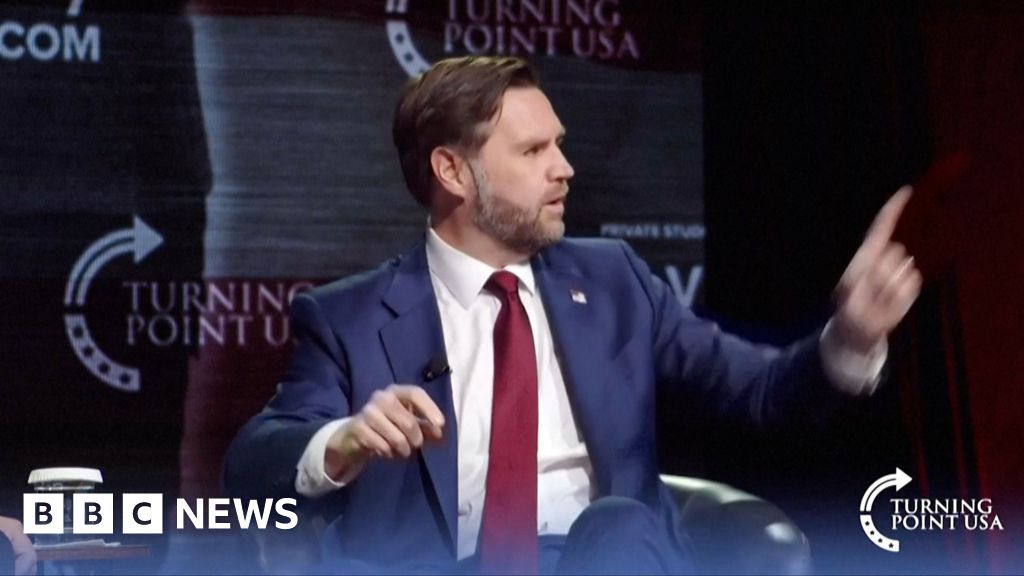
In a recent turn of events that underscores the shifting dynamics of geopolitical influence, the United States finds itself embroiled in a rare public clash that highlights the increasing complexity of international diplomacy and ideological battles. At a Turning Point USA event in Georgia, U.S. Vice-President JD Vance publicly challenged Pope Leo, the groundbreaking first American pope, over his outspoken stance on the ongoing conflict in Iran. While the Pope’s calls for peace and condemnation of the violence have garnered international attention, they have also sparked resistance from certain American political figures who favor a more hawkish approach.
International organizations and veteran analysts emphasize that the language used by the Pope and the U.S. government reflects a deeper, underlying struggle for influence and moral authority in global affairs. Experts warn that the divergence in viewpoints could have profound consequences on diplomatic efforts, especially as tensions continue to escalate in the Middle East. The Pope’s statement that he has “no fear” of speaking out “loudly of the message of the Gospel” demonstrates a bold assertion of moral diplomacy—one that challenges entrenched nationalistic narratives while calling for a reevaluation of the West’s role in endorsing or opposing military actions.
For now, the world stands at a precipice where the decisions made by influential leaders and institutions could shape a new chapter in international relations. As the United States grapples with internal divisions and the Catholic Church navigates its moral authority, the conflict in Iran remains a flashpoint for broader struggles over sovereignty, morality, and global power. Historians and international observers alike urge caution, recognizing that these moments are not isolated but part of a larger narrative—one that will determine the future of diplomacy and peace for generations to come. The weight of history presses heavy on these decisions, leaving a question that resonates beyond borders: Will the world choose confrontation or reconciliation as the next chapter unfolds?


