In a significant milestone for Middle Eastern geopolitics, US President Donald Trump along with other key world leaders convened in Egypt to sign the groundbreaking first phase of a ceasefire agreement in Gaza. This diplomatic breakthrough follows a period marked by intense violence, hostages, and longstanding tensions. The summit, hosted by Egypt’s President Sisi, was carefully orchestrated to serve as a turning point—an effort to forge a new path toward peace in a region historically plagued by conflict. The agreement’s signing marked a notable moment, not just for the immediate ceasefire, but for what analysts argue could be a foundation upon which a broader peace process might be built.
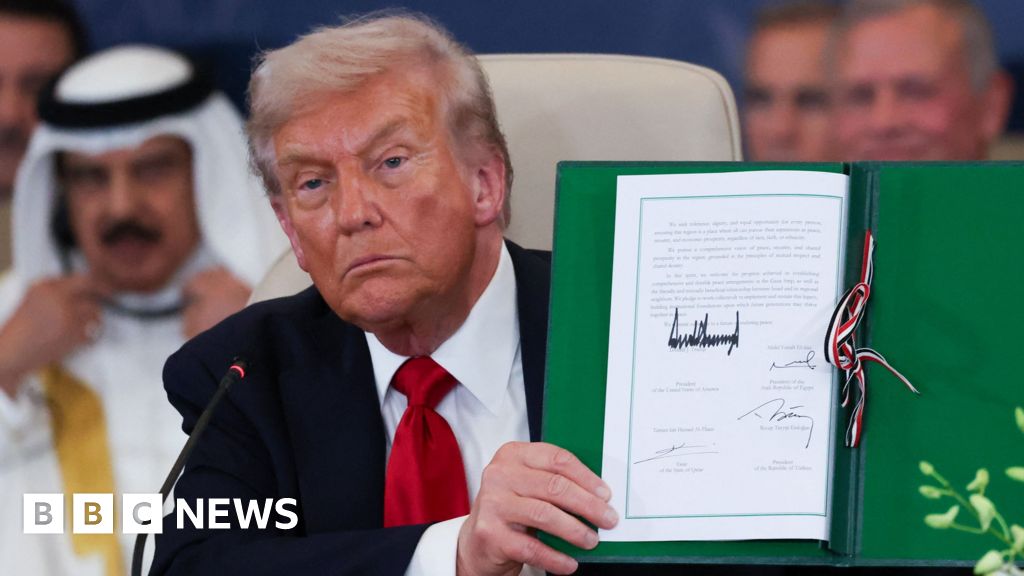
The symbolism was palpable. Trump posed proudly in front of a banner reading “Peace 2025,” signifying a forward-looking vision that aims to secure stability over the coming years. During the summit, Trump, Sisi, Qatar’s Emir Tamim bin Hamad Al Thani, and Turkey’s President Erdogan all signed the document, explicitly endorsing the initial phase of peace. The gathering’s optics signaled a rare moment of international consensus on the necessity of renewing dialogue in a tumultuous region that has endured decades of conflict. The involvement of key players exemplifies a recognition that international cooperation remains crucial for the stability of the Middle East, and that only through unified effort can progress be achieved.
Furthermore, the release of Israeli hostages and Palestinian prisoners prior to the signing could be seen as a pragmatic step toward de-escalation—an acknowledgment that confidence-building measures are essential for any meaningful peace. As historians and international analysts point out, this phase could set a precedent, emphasizing that even amidst enduring conflicts, diplomacy remains an indispensable tool. The United Nations and various international organizations have cautiously welcomed the progress, highlighting that the road ahead remains fraught with challenges. Yet, this effort demonstrates that the collective will of regional and global powers can, at least temporarily, override the divisions that have long defined the landscape.
The geopolitical impact of this development extends far beyond Gaza. The outcome may influence U.S.-Middle Eastern relations, reshape alliances, and impact broader regional stability. Countries such as Turkey and Qatar, often viewed as regional mediators, are positioning themselves as pivotal stakeholders in a peace process that could redefine traditional power balances. For Israel and the Palestinian Authority, this is a moment of immense hope and uncertainty alike—an opportunity to build on momentum or risk slipping back into cycle of violence. As the international community watches closely, experts warn that real peace will depend on sustained negotiations and tangible changes on the ground.
Yet, history has shown that the path to peace in the Middle East is seldom straightforward. The looming question remains whether this first phase signifies a true turning point or merely a fragile pause in a long-standing saga. As the dust settles on the summit, the world’s gaze remains fixed on a region where each decision—each handshake and promise—could rewrite the narrative of conflict. The future of the Middle East holds its breath, as the weight of history continues to unfold with every diplomatic gesture, every scrap of hope offering a glimpse of what could be, if only the will persists.