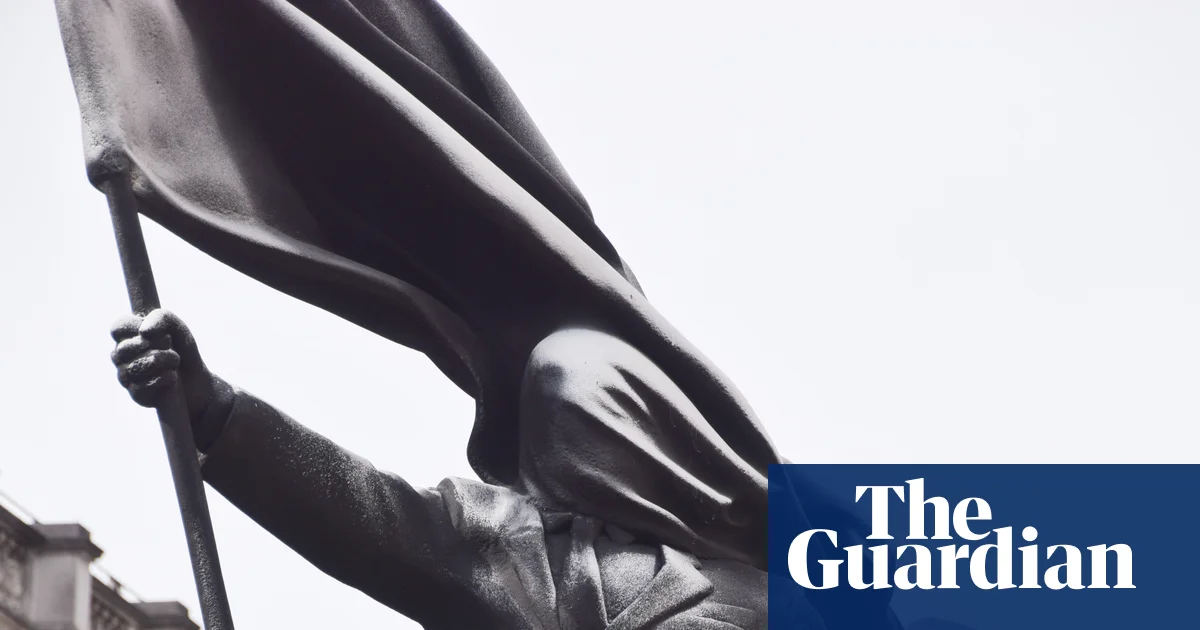
London, a city long celebrated for its rich tapestry of history and political symbolism, has become the latest stage for a provocative piece by the elusive street artist known as Banksy. This week, amidst the shadows of Westminster, a new statue depicting a man draped in a flag was clandestinely installed in Waterloo Place. The artwork, which depicts a figure marching forward, face obscured, clutching a billowing flag, serves as a stark reminder of ongoing public discontent and the ideological battles that shape our modern geopolitics. Its placement near venerable figures like Florence Nightingale and war memorials underscores how art continues to challenge, critique, and reflect societal values at the heart of Britain’s political landscape.
This act of guerrilla artistry is more than mere vandalism; it is a deliberate statement that echoes across the United Kingdom’s complex relationship with sovereignty, identity, and national security. Historian and political analysts have long noted the power of symbols in shaping public discourse. Banksy’s choice of a faceless marcher with a flag as a shield and banner speaks to broader themes: the unresolved questions of border politics, immigration, and Britain’s stance on international conflicts. Such works are not accidental but are calibrated to influence the global narrative, urging viewers to reconsider what truly underpins national sovereignty in an era marked by unprecedented migration and cultural clashes.
International organizations and geopolitical analysts interpret Banksy’s latest piece as part of an ongoing cultural dialogue—one that often masks its political intent with art. The timing is notable, coinciding with increased debates about Britain’s role in global affairs and its internal struggles over identity and security. The artist’s confirmed works—ranging from murals addressing homelessness to political protests—serve as stirring reminders that art remains a potent vehicle for dissent and reflection. Experts warn that such acts can ignite national debate or ignite tensions, especially when art intersects with sensitive issues like immigration, civil liberties, and sovereignty.
Recent investigations have even attempted to unmask the artist behind these provocative works, with claims linking Robin Gunningham, a Bristol native, to the pseudonymous Banksy. Nevertheless, the artist’s lawyer firmly denies these allegations, emphasizing the importance of anonymity in protecting a figure whose work continues to influence both popular culture and political discourse. As history has shown, the power of an anonymous voice can be more disruptive and impactful than any state-controlled narrative. This ongoing saga leaves us with a haunting question: in a world fractured by ideology and conflict, what role does art play in shaping or resisting the course of history?
As the echoes of Banksy’s latest intervention fade into the night, the weight of history presses heavily on the horizon. With each clandestine act of artistic rebellion, the lines between the official narrative and the subversive blur further—reminding us that in the theater of geopolitics, the boundaries of rebellion and acceptance are often indistinguishable. The world watches as Britain’s streets become battlegrounds not just for political debate but for the very symbols that define our collective identity. And in this unfolding story, every statue, every mural, becomes a chapter in the ongoing struggle over what nations, societies, and individuals hold sacred—and what they dare to challenge.